“Une fenêtre historique,” by Frédéric Lordon, first appeared on 20 May 2026 under the heading “Politique de la crise financière – 1,” as an installment of La pompe à phynance, Lordon’s column at Le Monde diplomatique.
“The looming financial crisis will present us with a unique opportunity to do what the corrupt brand of government socialism has always refused to do: take on the head of the snake—neoliberal finance.”
— Frédéric Lordon
This text is the first in a series of three (or more…). Their aim is to discuss something simple in principle, though less so in execution. The onset of a financial crisis on the scale of the one looming does not call for management measures but for political action. Neoliberal finance is a structure so powerful, so enslaving, that when it does us the favor of collapsing on its own, it is impossible to miss it. We thus engage in politics—transformative politics. This crisis, for which all the elements are in place, has not yet begun. It will come—likely in the fourth quarter. That leaves a little time to prepare. Because we’ll need to be ready. This three-part series is intended to help with that.
What does it mean to be on the left? It means pushing back the grip of capital as far as possible—that is, ultimately, all the way to the end. What is the end? Moving beyond capitalism.
But the end is far off, and the political conditions for reaching it are exacting: 1) having a minimally developed vision of what we’ll do “afterward,” 2) winning over a sufficient portion of the population to help them see the necessity and benefits of moving beyond capitalism, but also to prepare them to accept the consequences. So: the end is far off. We must see this as both an urgent duty to move toward and reach such end and a necessity to assess the possibilities of the moment without telling ourselves stories.
In the meantime, the contemporary form of capitalism is the one that has historically maximized its grip. On the economy, of course, and in fact on the whole of society. How does this grip manifest itself? Through the deregulation of all markets: the capital goods market to promote foreign direct investment—that is, offshoring—and pit regions against one another in competition; the goods- and services markets to boost productivity and keep labor costs in check; and finally, the labor market to maximize the impact of the other deregulations. But all these deregulations are overseen by a higher-level deregulation that subordinates them all and intensifies them all: the deregulation of capital markets. In a sense, all these deregulations are merely instruments for the ultimate goals set within the sphere of capital markets—and by the deregulation of capital markets itself—namely, the maximization of the return on capital in its form as financial capital.
It is this hierarchical arrangement of deregulations that leads us to redefine “neoliberalism” more precisely as finance-dominated deregulatory capitalism. Finance, in the form of deregulated capital markets, is thus its head, its nerve center. Consequently, in the absence of conditions conducive to moving beyond capitalism—and without prejudice to the political work required to bring such conditions about—the left’s endeavor to move beyond this form of capitalism—an endeavor that constitutes a sort of minimum standard for left-wing politics, leaving it to all right-wing forces to manage the status quo and things as they stand—the left’s endeavor must target the head: finance. There can be no left-wing politics that does not target the head. If “left-wing politics” means rolling back the grip of capital—and thus altering the structural conditions of that grip—then it must take on neoliberal finance. Vigorously.
5 Reasons (to Put an End to Deregulated Finance)
Everything leads to this. The two paths of neoliberal finance are equally harmful. The shareholder-driven path, through which the structural primacy of financial capital’s profitability is expressed in its purest form, is the enforcement arm for bringing labor to heel. The debt-driven path is one of disciplining States according to the interests of bondholders, and of dismantling socialized collective functions in order to hand them over to private capital—that is, to general commodification. If that were all there were to it, we would already have a first and a second categorical reasons to put an end to neoliberal finance.
It also turns out that, in addition to mistreating the entire population that has no ties to capital, finance—and the people in finance—derive fabulous wealth from this mistreatment, which constitutes a third reason.
It is also the case that deregulated finance is at the root of recurring, violent, and sometimes cataclysmic crises—in terms of their impact on the real economy. Although the real economy is completely removed from the frenzy of the bubble—and even more so from its obscene profits—it will nonetheless suffer the repercussions of the banking system’s violent reactions when it restricts credit with as much brutality toward producers as it has granted it with laxity to those in finance. This will result in recession and unemployment. This is utterly intolerable—and that is the fourth reason.
Finally, it turns out that when their own excesses have brought them to the brink of ruin, the major financial institutions—banks first and foremost, but also insurance companies and all the major collective investment managers—ask to be saved from complete bankruptcy. And they get it. Not merely because of collusion among bourgeois elites who move freely between the State and capital, but for the compelling reasons of systemic risk. These are reasons that are impossible to swallow. And yet we must accept them. For the perverse joy of seeing the banks finally brought down would last only a fraction of a second—before we are plunged into the same abyss in their wake. We must imagine the chaos that would result from allowing systemic risk to run its course to its ultimate consequences: the entire banking sector collapsed, no cash available at ATMs, not a single check that could be processed, and bank transfers, of course, impossible. In addition to safeguarding the public’s assets, banks constitute the payment infrastructure. This means that if there are no more banks, there is no longer any way to conduct transactions. All production and commerce would grind to a halt instantly. All that would remain is the little cash that people have in their pockets at that moment, and whatever is left of food in the fridge and the cupboards—basically, enough to last a few days. And after that, who knows… It is unthinkable to let the banks go bankrupt; we must save the banks. No matter what. From the four previous reasons follows a fifth one—to no longer tolerate this. Bailing out the banks only to let them resume business exactly as before, without ever making them pay the price—not just the monetary price but the price of structural reform—is something a left-wing policy cannot tolerate.
A self-locking system
The problem is that the neoliberal financial system forces us to tolerate the intolerable. The structures of deregulated finance not only occupy a hierarchically superior position within the overall institutional framework of contemporary capitalism (its “mode of regulation”); they also possess a remarkable self-locking property. That is to say, they have the means to thwart any government that would attempt to transform them in a way that does not align with their interests.
The financial sector has made itself untouchable through deregulation that has created a sanctuary for its domain. The corrupt brand of government socialism has collaborated in establishing this system and maintaining it, right up to crises of immense proportions, such as that of 2008, which nevertheless opened an unprecedented window of opportunity to shut down the circus—yet there was barely even a pretense of taking advantage of it.
There is no need to assume the existence of any hidden concerted effort to understand this: all actors in the deregulated financial sector are in complete agreement from the outset regarding their vision of the financial world and what its structures should be, and they all have the same tool at their disposal to respond to any economic policy that would challenge them (as, more generally, to any economic policy they find objectionable): the sale—potentially on a massive scale—of government debt securities. This results in a rise in interest rates, the extent of which no one can predict; it could potentially reach very high levels if, therefore, “the markets”—that is, in fact, the collective body of financial operators—consider that they are facing an attempt to dismantle their world.
Raising interest rates to these levels is more than just a reaction of “disapproval”: it is a symmetrical act of counter-destruction. “We will destroy the government that seeks to destroy us—and we have the means to do so.” Indeed: they do have the means. Skyrocketing interest rates literally shatter the economy: the public finance sector, through an explosion in the debt burden and the crowding out of all other public spending, or through an abysmal widening of the deficit and another round of rate hikes; the private sector, where any borrowing becomes prohibitively expensive—in fact, impossible—and it’s not even that growth is being hampered; rather, the recession is going to be devastating.
The financial sector has made itself untouchable through deregulation that has created a sanctuary for its domain—a privilege for which, in France, it owes a debt of gratitude to the Socialist Party. The Socialist Party not only collaborated—and that’s putting it mildly—in establishing this system but also in maintaining it, even as its effects became increasingly and spectacularly evident, right up to crises of immense proportions, such as that of 2008, which nevertheless opened an unprecedented window of opportunity to shut down the circus—yet there was barely even a pretense of taking advantage of it.
Since government socialism presents itself in much the same way across the globe, there was first Obama, elected in November 2008—that is, at the height of the collapse—Obama who, it is said, gathered the heads of the six or seven major Wall Street firms to deliver this speech to them: “Between you and the pitchforks, there is only me”—verbatim. One might have seen this as a fairly explicit acknowledgment of the actual balance of power and a warning that this time the merry-go-round was going to come to a halt. Instead, we got the Dodd-Frank Act, a re-regulation law as thick as it was toothless.
We also remember François Hollande, though he arrived a little later—by which time the subprime scandal had had time to reach its full scale and spill over into Europe. We remember the financial sector—first as an enemy, then very quickly as a friend—and the so-called Moscovici Act, which was supposed to separate investment banks from commercial banks. It was a pitiful effort from the start, then literally gutted by the Bercy-banking lobby axis, which was perfectly complicit—in perfect alignment, in any case, with the guiding principles of government socialism.
Finally, in a different vein—but perhaps the most damning—there were the French union leaderships, who, having only half-grasped the fury of public opinion, did indeed decide to hold a national demonstration in January 2009—the turnout was enormous. But under the feeble slogans of “wage increases” or “sharing of wealth and working hours”—poor, toothless phrases, long since worn out—even as an unprecedented opportunity was opening up, the first in three decades of neoliberal globalization, to make a political statement and finally challenge financialized capitalism. The window was wide open, popular anger at its peak, the arrogance of the opposing camp in tatters—an invitation to rearm ideologically and shake everything up: and yet all we “demanded” was a “better distribution of wealth.” It was enough to make one weep at the sheer stupidity and futility of it all.
Windows and Porches
But now history, which isn’t exactly known for doing us such favors, seems to be serving up the same dishes all over again. And not only serving them up again, but on a gargantuan scale. The looming crisis is of extraordinary proportions—a multi-faceted financial crisis on one hand, a massive commodities shock on the other, all topped off by the explosive synergy of their mutual amplification, a total crisis for which we search in vain for a precedent in the history of capitalism—and which is thus bound to create an unprecedented political situation. For we find ourselves in the unique circumstance in which what is ordinarily impossible becomes possible: reining in finance because its self-imposed lockdown has collapsed. It has broken down because financialized capitalism has fallen flat on its face all by itself; it must be propped back up; it is in the most extreme dependence on whoever comes to its aid; and whoever props it back up has the opportunity to do so on their own terms—provided they are willing to do so, and have a few ideas of their own.
There aren’t that many “who’s”; there is only one: the government. Should the government fail to act, the ruin would be total, absolute, and definitive, as systemic risk would bring down all financial institutions one after another in a lightning-fast spread of the liquidity crisis—thereby reducing the economy to barter and foraging. That was the fifth reason. But above all, this time, it is the first opportunity: the opportunity to take everything back into our own hands—that is, to do everything that the corrupt brand of government socialism has always refused to do: take on the financial sector.
.
The legitimacy of deregulated finance—which has been shielded from scrutiny or well-protected by orthodox economic rhetoric, with its arguments about “market efficiency” ridiculed during every crisis yet trotted out again after each one—is shattered the moment it collapses—temporarily. This is a political moment that we must seize.
Everything is in ruins means that the catastrophe is visible to all—it is global. That the bailout of the irresponsible is being extorted from us. That the macroeconomic and social effects will be devastating. Consequently, that the scandal is enormous. The legitimacy of deregulated finance—which has been shielded from scrutiny or well-protected by orthodox economic rhetoric, with its arguments about “market efficiency” ridiculed during every crisis yet trotted out again after each one—is shattered the moment it collapses—temporarily. This is a political moment that we must seize. To state what can never be stated otherwise: the reign of deregulation must come to an end; we are going to put a stop to it. This is the only time we can do so since the players who would normally be in a position to retaliate are far too busy fighting for their survival. And the public—usually a world away from the incomprehensible intricacies of finance—suddenly perceives all the fundamental issues with the utmost clarity. Consequently, it will give its full support to any government that offers it the chance to vent its frustration on the financial sector by proxy. We call this a historic window of opportunity. At this point, in fact, it’s no longer a window—it’s a veranda.
And now, to complete the picture, an upcoming election is on the horizon, in which a political party is positioned quite prominently—one that might be tempted to seize the opportunity—and which, in any case, will have the chance to do so. A left-wing party, for once. Certainly not in the “literal” sense, not “to the very end” (pushing back the grip of capital to the very end), but perhaps enough to at least take on the financialized, deregulated form of capitalism, thereby changing its very nature—very profoundly, in fact—and in doing so bring about a new regime of accumulation, a new historical phase, a new balance of power between capital and labor—drastically shifted back in favor of labor—a transformative undertaking that is normally an integral part—normally a minimal part—of any left-wing perspective. Made impossible for four decades. Finally within reach.
Let’s see how.
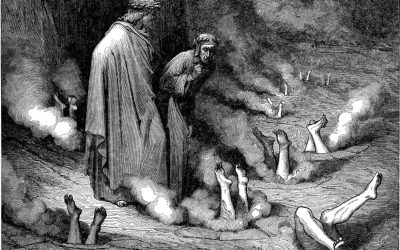
Feature image: Gustave Doré, illustration for John Milton’s Paradise Lost, engraving (1866). Detail. Wikimedia Commons.
Translated from the French original by Rolando Prats.